OUR STORIES
THE TRACKER ORGAN
The church organ is a tracker-action organ built by George S. Hutchings of Boston in 1885. It is a “tracker” organ because the connection between each key and its pipe is made by a series of wooden pivoting arms and a long thin strip of wood about the dimension of an old-fashioned flat popsicle stick called a “tracker.”
Our organ, with the console at one corner and the pipes at the other, is known for excellent tone and famous for its unusually long 24-foot trackers. The long trackers give it an unusually heavy action for the organist, requiring more physical exertion. New England tracker organ enthusiasts appear from time to time to remind us what a treasure we have and make sure we don’t trade it for a cheaper, smaller electric console that is willing to play rumba rhythms at the touch of a button.
The organ started its life, not in Danville, but at the First Universalist Church in Claremont, New Hampshire. How it arrived here in 1924 is a story of high drama and Yankee flim-flam. Claremont was in the market for a new, smaller tubular-pneumatic organ. The Estey Organ Company of Brattleboro, Vermont, was in fierce competition with two other companies for the job. Estey’s man in the field was J. W. Morrison, an experienced shop man, but new to the sales end of the business.
The Claremont people allowed as how, if Morrison could find a buyer for their old tracker organ, he could have the contract. At the same time, Danville had been in the market for a pipe organ for some years. Morrison persuaded them the Claremont unit would be a good purchase at $1,250.00. To clinch the deal, however, Morrison had to agree to a second contract, under which Estey would dismantle the Hutchins organ in Claremont, transport it to Danville, and re-install it at its new location, for $750.00. Mr. J. G. Estey, sitting in his office in Brattleboro contemplating the set of executed contracts before him, dashed off a letter to the hitherto tickled Mr. Morrison,
In reference to the handling of the old organ with the Danville Church, if there is any way to get out of this, we should, of course, like to do it, because none of our men are familiar with the handling of tracker actions and to take down and re-erect an old organ with tracker action is, as you know, a rather delicate job.
Ernest E. Hartshorn was the chairman of the Danville committee. Mr. Estey never got out of the contract.
Although the report of the eventual dedication service described the organ purchase as “the fulfillment of [a] long-cherished desire,” the decision, whether it was the choice of instrument, or the cost, was controversial within the church. There were setbacks and delays in the installation. At one point, Morrison wrote Estey that the delays were “like pouring oil on the fire” for these people. Later on, Ernest and Nellie Hartshorn took advantage of business in the southern part of the State to stop in on Mr. Estey. He duly wrote Mr. Morrison that Mr. E.E. Hartshorn and wife had been there “and the visit was not entirely rosey.”
Some of the delays were occasioned by the banishment of the organ console and the pipe box to opposite corners of the church. Interestingly, this decision was blamed by the Estey representatives on the church people, while we have always blamed it on Estey. “Blame” is not a good word. The decision required fabrication of new side panels for the formerly joined console and pipe box. It made the organ more difficult to play. But it had the inspired consequence of leaving the altar, and not the organ pipes, at the center of the sanctuary. Certainly, the Lord moves in mysterious ways. The very modern asymmetrical design decision by which we placed our main stairwell and access lift several years ago might never have occurred to us absent the asymmetrical placement of the organ in 1924.
Another piece of inspiration, actually ancient parsimony converted to modern recycling, was the use of the wooden packing boxes in which the organ was shipped from Claremont, to build the raised platform which protects the trackers and provides a base for the altar and pulpit. In 1924, the intention was that the rear of the platform would be a space for the choir. We have found over the years, however, that when the choir is large, as it currently is, the weight of its contribution on the platform, deflects some of the trackers, and causes the organ to sound as if it had stuck keys.
The installation work, which took seven months, was finally completed in time for a dedication ceremony Sunday morning November 30, 1924. The original dedication in Claremont in 1885 has been dismissed by Mr. E. A. Boadway (who watches over our organ) as a concert which was “unusually non-sacred and made little use of the organ… One can hope that the dedication of the organ in Danville was an event less secular in musical content!” It was certainly less secular. We were joined by the Danville Congregational and West Danville Methodist congregations, our district superintendent, and “Mrs. Orpha Davis, who has been an invalid for many years, [and] was able to attend for the first time in 25 years.” All of the music was choir-accompanied, and the compositions popular in that period but now unknown. Later that evening, the organ was called upon to support “an operetta entitled ‘The Kingdom of God,’ by E. K. Heyser … rendered by the choir.” However, finally, on Monday evening, December 8, a recital was given by Mrs. Margaret Gorham Glaser of Boston, at which time “the capabilities of the pipe organ [were] fully exhibited.”
We have enjoyed occasional concerts over the years by visiting professional organists, who can make the organ sing in ways our routine service needs do not require. We appreciate those times when the slumbering soul is awakened. One of the most extraordinary concerts ever heard occurred one Sunday morning in January, 1986. Emerson Lang was playing the organ prelude before the service, when he suddenly and unexpectedly launched into an atonal, rhythmically-complex, shrieking, wildly post-modern composition that was quite outside of anything that had been in Emerson’s repertoire for his 80 odd years, or the organ’s for its 100 odd years.
The source of the composition, as it turns out, was the organist’s assistant, Fang, the longhaired yellow tiger cat who consented to reside at the home of our neighbor and friend Alice Hafner. Fang had long held a reputation for supporting the ministry and other activities of the church. More than one local bride could tell of being escorted to the altar by her father at one hand and the dignified yellow tiger cat at the other. This Sunday morning, awaiting the call to worship, Fang gained access to the trackers through a small, cat-sized cubby hole in the rear of the platform and commenced, unsuccessfully, to walk across the tops of the trackers. The damage was repaired, the cubby hole closed, Fang retired, and no one since has ever duplicated a performance truly “other-worldly.”

THE BELL
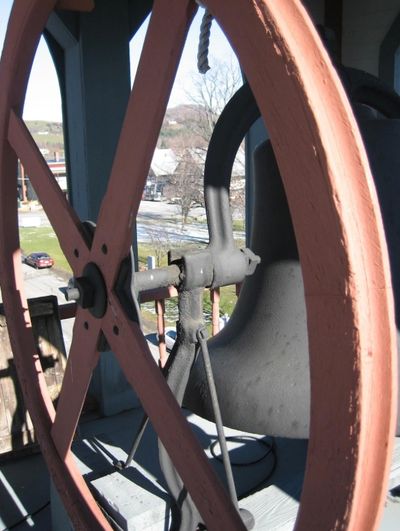
The bell, when properly rigged, rings two ways. A large rope wraps around the wheel, swinging wheel and bell with the clapper hitting one side and then the other. The smaller rope is attached to a small hammer mounted on the floor below the bell, tapping it on the inside while the bell remains stationary, when tolling of the bell is called for, a more muted sound. The bell was cast at a foundry in Concord, VT.
Through the late 1970s, at the end of a period when Danville Methodist and Danville Congregational were the only churches in the village (although the Queen of Peace Roman Catholic church had begun to organize in the early 1960s), both the Methodist and the Congregational church began their Sunday service at 11 am, and the sextons of the two churches would ring their bells responsively, at 9:30 am, 10:30 am, and five minutes before 11 am.
The Methodist bell would begin the sequence, because the sexton could step out the front door and read the time from the town hall clock. The Congregational church faces the back side of the town hall cupola, which lacks a clock face.
Each sequence was different, and had a different meaning. One of the first two, either the 9:30 or 10:30, was two peals repeated three times (bong-bong, bong-bong, bong-bong), which signaled, “Get dressed, get dressed, get dressed”. At five of 11:00, the bells tolled simultaneously to the hour, “Come, come, come, … ”.
Were the 9:30 and 10:30 sequences identical, with the 9:30 calling, “Wake up, wake up, wake up”? No one locally remembers. This was not a purely local tradition (the Congregational church in Craftsbury Common, for example, had the same tradition). Perhaps someone, somewhere, recalls, or has written down the entire sequence.